
Best Left-Handed Vertical Mouse (Wireless + Rechargeable, 2026)
Ranked left-handed ergonomic picks with wireless reliability, rechargeable vs battery tradeoffs, and practical office comfort insights.
Updated 2026-02-25
Quick Verdict (60-Second Read)
Definition: A vertical mouse keeps your hand in a handshake posture to reduce forearm pronation and lower wrist strain during long desk sessions.
Best overall in this guide: Logitech Lift Left. Best value: Evoluent VerticalMouse D Left. Best premium alternative: Evoluent VerticalMouse 4 Left.
Best overall left-handed value
Logitech Lift Left
Rating: 4.7/5 · Price: $$
Best premium ergonomic depth
Evoluent VerticalMouse D Left
Rating: 4.5/5 · Price: $$$
Best for clinical-style finger support
Evoluent VerticalMouse 4 Left
Rating: 4.4/5 · Price: $$$
Jump to comparison table if you want specs fast, or keep reading for fit-by-use-case guidance.
Editorial Transparency
Author: Vertical Mouse Guide Editorial Team · Last reviewed: 2026-02-25. We evaluate comfort, fit, workflow reliability, and value tradeoffs for real office usage.
See our About / methodology, affiliate disclosure, and privacy policy.
Medical note: This guide is educational and does not replace diagnosis or treatment advice from a qualified clinician.
Infographic: Left-Handed Wireless vs Rechargeable Decision Grid
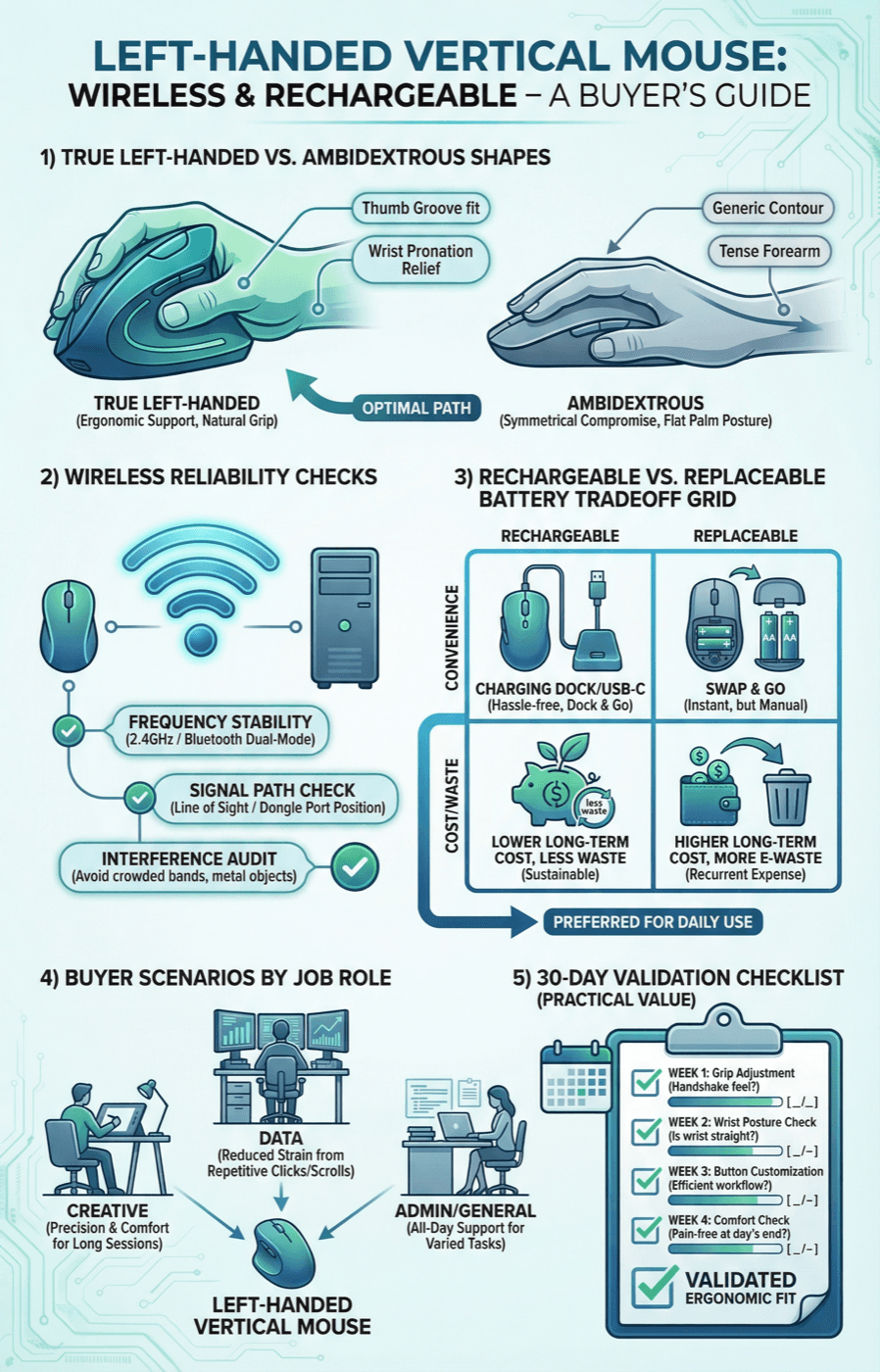
30-Second Video: Best Left-Handed Vertical Mouse (Wireless + Rechargeable, 2026)
30-second walkthrough for best left-handed vertical mouse (wireless + rechargeable, 2026).
Quick Answer: Best Left-Handed Vertical Mouse (Wireless + Rechargeable, 2026)
Most left-handed buyers get a fake choice: either buy a right-handed model and adapt, or settle for an under-specced lefty mouse with weak battery life.
The key buying rule is simple: prioritize shape and switch feel first, then power system, then connectivity extras.
You will see both built-in rechargeable and battery-powered wireless options here. That is intentional.
Key takeaway: pick the smallest mouse that still supports your palm, then prioritize low click force.
Semantic intent covered: left-handed ergonomic mouse, left-handed vertical mouse wireless, rechargeable left-handed mouse, and office-comfort fit tradeoffs.
Top Picks Quick Comparison
Fast shortlist for decision-first readers. Full table remains below for complete detail.
| Product | Best For | Price | Rating |
|---|---|---|---|
| Logitech Lift Left | Best overall left-handed value | $$ | 4.7/5 |
| Evoluent VerticalMouse D Left | Best premium ergonomic depth | $$$ | 4.5/5 |
| Evoluent VerticalMouse 4 Left | Best for clinical-style finger support | $$$ | 4.4/5 |
| Perixx PERIMICE-719L | Best budget wireless left-handed | $ | 4.2/5 |
| Adesso iMouse E10 Left | Best straightforward office starter | $ | 4.1/5 |
Who This Left-Handed Guide Is Built For
This guide is for left-handed buyers who want a real purchasing decision, not generic ambidextrous advice. If you work 6+ hours daily and your current mouse causes thumb pinch, ulnar wrist ache, or forearm tension, this framework will save you trial-and-error money.
- You need a true left-hand shell, not an “okay for both hands” compromise.
- You care about wireless reliability and recharge practicality.
- You want explicit tradeoff guidance across 10 realistic models.
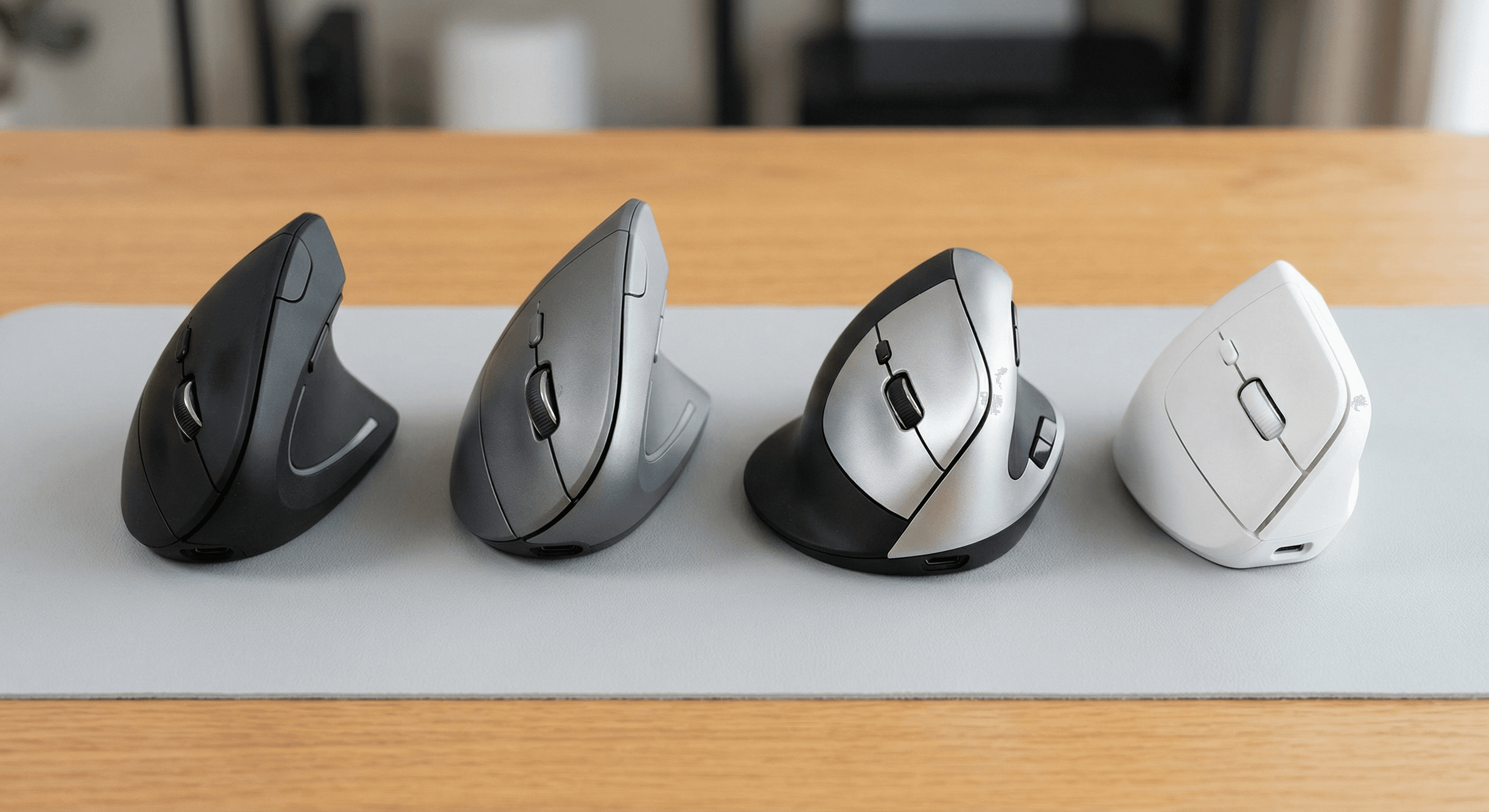
Our Left-Handed Selection Methodology (How Winners Are Chosen)
Left-handed ergonomic inventory is smaller than right-handed inventory, so we use a stricter filter before ranking. First, the model must have recurring real availability. Second, shape quality must support neutral wrist posture for left-thumb users. Third, power behavior must be predictable: either stable built-in recharge cycles or reliable replaceable battery economics.
Scoring weights: fit and hand geometry 35%, long-session comfort 25%, wireless/recharge reliability 20%, and value + support 20%. This weighting is intentionally buyer-centric. A mouse with premium materials but weak fit still loses.
- Fit: left thumb rest height, finger ledge stability, click reach without stretching.
- Comfort: fatigue trend over long sessions, click force, pressure concentration points.
- Power & connectivity: wake consistency, dropouts, recharge friction, battery replacement ease.
- Ownership confidence: return policy, warranty reputation, replacement availability.
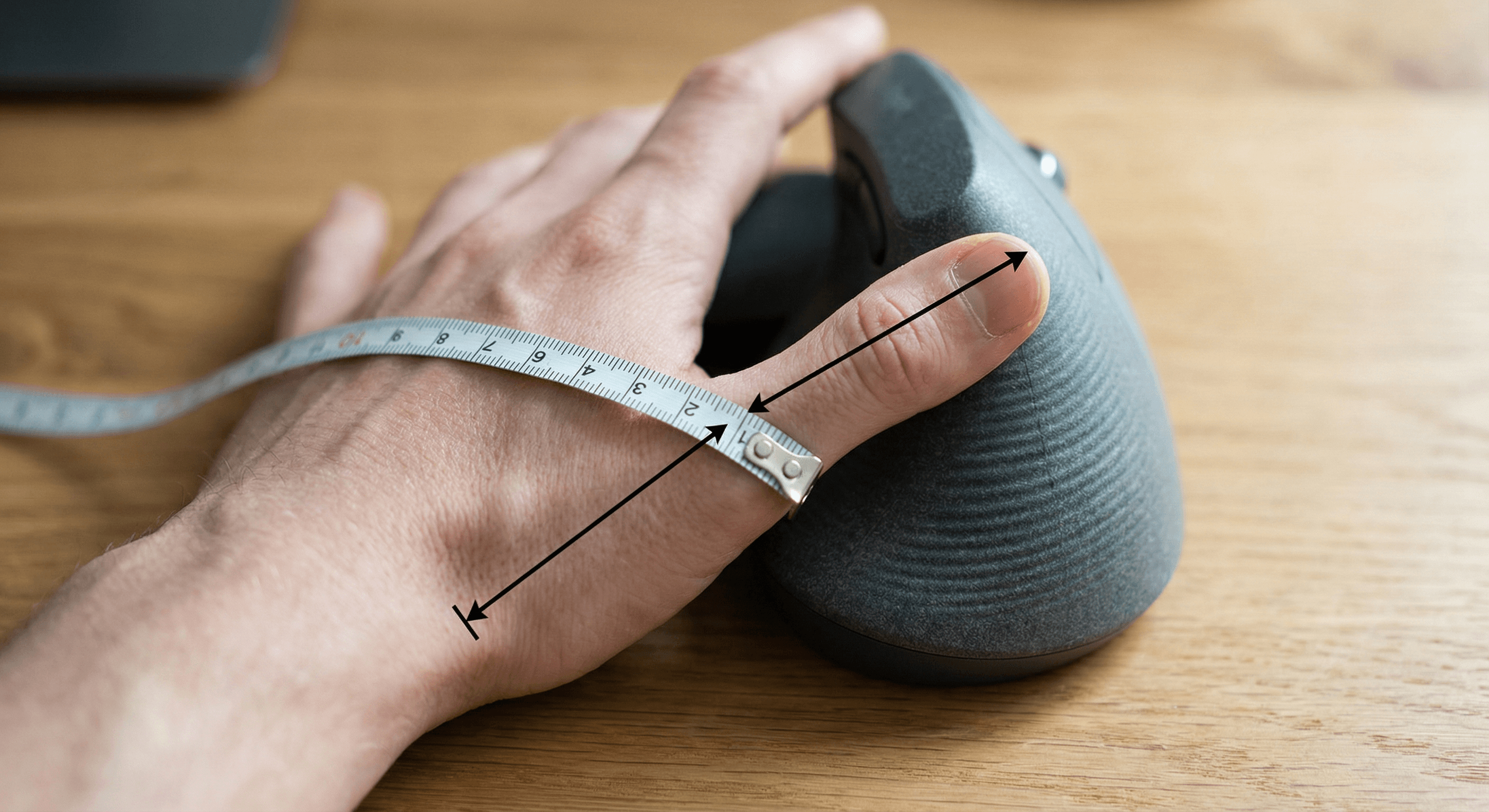
10 Left-Handed Models: Explicit Tradeoff Analysis
Logitech Lift Left: Best balance for most buyers. Excellent shape confidence and low click effort. Tradeoff: premium vs budget left-handed options and not full USB-C recharge because battery-based design favors long replacement cycles.
Evoluent VerticalMouse D Left: Strong premium ergonomic profile with deep hand support. Tradeoff: higher adaptation curve and premium pricing.
Evoluent VerticalMouse 4 Left: Clinical-feel shape with pronounced finger channels. Tradeoff: aesthetics and software simplicity are dated compared with mainstream options.
Perixx PERIMICE-719L: Budget wireless buy for test-driving vertical posture. Tradeoff: click consistency and shell finishing can vary unit-to-unit.
Adesso iMouse E10 Left: Straightforward office performer with no-nonsense setup. Tradeoff: fewer premium tuning options and less refined scroll feel.
Kensington Pro Fit Left Vertical: Safer transition angle for first-time vertical users. Tradeoff: less aggressive pronation reduction than steeper shells.
CHERRY MW 4500 Left: Compact, travel-friendly geometry. Tradeoff: smaller shell can feel cramped for large hands.
Delux M618LU Left: Rechargeable value with practical features. Tradeoff: long-term switch consistency is less predictable than top-tier brands.
3M Wireless Ergonomic Left: Neutral-angle comfort profile for some pain patterns. Tradeoff: bulky form and premium cost for niche preference.
Nulea M503 Left: Low-cost tri-mode utility choice. Tradeoff: quality-control variance and lower confidence for high-intensity workflows.
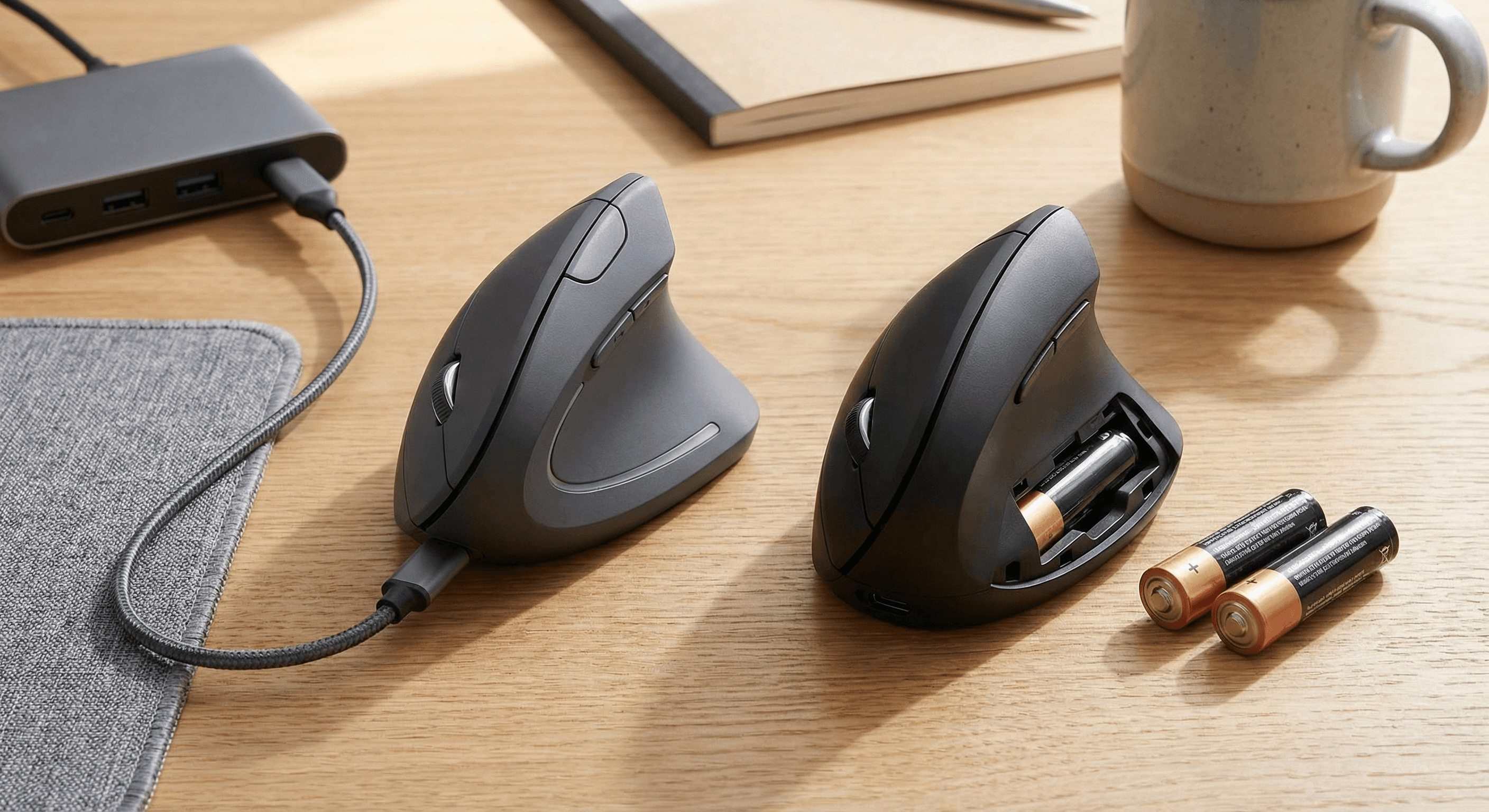
Wireless vs Rechargeable: What Actually Matters in Real Use
Buyers often ask for “wireless and rechargeable” as if that is always superior. In left-handed vertical mice, it depends on your operating style. If you need no-interruption reliability in corporate settings, quality battery-powered wireless can outperform budget rechargeable internals over time. If your desk is cable-minimal and you recharge devices weekly anyway, built-in recharge may be cleaner.
Choose built-in rechargeable when: you want less battery waste, stable charging habits, and minimal accessory purchasing. Choose replaceable battery wireless when: uptime continuity and long cycle life matter more than charging convenience.
For hybrid users, prioritize wake latency and signal stability over headline battery claims. A mouse that “lasts months” but wakes slowly or drops connection during calls is not productivity-grade.
Common Left-Handed Buying Mistakes (And How to Avoid Them)
Mistake 1: buying by feature list before shape fit. Buyers frequently over-index on DPI, RGB, app controls, or multi-device pairing without first confirming hand geometry. If the shell forces extension in your left thumb or curl in your ring finger, those features become irrelevant by week two.
Mistake 2: assuming rechargeable equals premium. Rechargeable convenience is real, but battery design quality varies dramatically. A robust replaceable-battery mouse can deliver better long-term confidence than a weak internal cell with inconsistent charging behavior.
Mistake 3: deciding in one day. First impressions can be misleading because unfamiliar posture changes can feel awkward before they feel better. Use repeated workloads over multiple days to judge genuine comfort sustainability.
Mistake 4: ignoring desk context. Left-handed users often compensate around right-optimized desk layouts. If your keyboard and mousing zone force shoulder abduction or wrist extension, no mouse can fully solve the issue alone.
Mistake 5: skipping return policy quality. In smaller left-handed product categories, availability changes quickly. Strong return windows and support responsiveness matter more than in mainstream categories.
Practical rule: shortlist two models from different tiers, test both in your heaviest work blocks, and keep the one that gives the lowest end-of-day soreness while preserving speed. This process beats spec-sheet comparison every time.
Role-Based Recommendations: Pick by Workload, Not Hype
Analysts and spreadsheet-heavy operators: prioritize low click force and reliable wheel behavior before connectivity extras. Your workload includes thousands of micro-clicks and scroll adjustments per day; stiff actuation compounds quickly. Lift Left and Evoluent D Left are usually stronger than bargain shells if you spend all day in grids and dashboards.
Project managers and communication-heavy roles: prioritize wake reliability, Bluetooth stability, and comfort over extreme sensor specs. You are constantly jumping between documents, meetings, and chat tools. A smooth handoff between laptop and desk setups matters more than peak DPI.
Creators and design-adjacent users: prioritize shape precision and controlled drag comfort. If your pointer work includes frequent click-hold operations, thumb support and ring-finger stabilization become critical for reducing fatigue spikes in longer sessions.
Developers and technical operators: choose consistent primary switches and predictable cursor behavior. You need fewer interruptions, not endless software tweaking. Medium complexity with stable defaults usually beats over-configured profiles.
When two options feel close, use productivity outcomes as tie-breakers: error rate, end-of-day soreness, and task completion speed. The best left-handed mouse is the one that reduces friction across your real week, not just your first ten minutes.
30-Day Ownership Checklist: Ensure You Bought the Right Model
Serious buyer guidance is not complete at checkout. The first 30 days determine whether a mouse becomes a long-term asset or an ergonomic regret. Use this checklist to validate your purchase with objective signals.
- Week 1: adaptation and control. Lower pointer speed slightly and monitor over-correction. Mild awkwardness is normal; severe thumb strain is not.
- Week 2: comfort stability. Track wrist and forearm status in morning, mid-day, and evening. Comfort should trend upward, not oscillate unpredictably.
- Week 3: productivity consistency. Compare task speed and fatigue against your previous mouse on similar workloads.
- Week 4: ownership confidence. Evaluate charging/battery rhythm, connection consistency, and switch feel durability under full workflow stress.
If pain increases or precision remains poor after two weeks, stop forcing adaptation and switch models. Wrong geometry cannot be trained away indefinitely. This is especially important for left-handed users because alternative options are fewer and replacement delays are common.
Also validate ecosystem fit: replacement receiver availability, software support on your OS, and return/warranty responsiveness. A mouse can feel good but still fail ownership quality if support is weak.
Final review question: “Can I use this device for six hours on my hardest workflow day without protective grip tension?” If yes, you likely made the correct buy.
Left-Handed Vertical Mouse FAQ (Practical, PAA-Style)
What is the best left-handed vertical mouse overall?
For most buyers, Logitech Lift Left is the best balance of comfort, consistency, and value. Premium Evoluent options can outperform for specific pain profiles but usually cost more and require longer adaptation.
Is a true left-handed mouse worth paying more for?
Usually yes, especially if you work full-time at a desk. A mirrored shell reduces awkward compensation patterns that ambidextrous models often trigger in left-thumb and left-wrist mechanics.
How do I know if a model is too large?
If you need to reach for primary clicks, or your thumb cannot rest naturally without extension, the shell is too large. Size mismatch causes cumulative fatigue even if specs look premium.
Can rechargeable left-handed vertical mice last several years?
They can, but battery health depends on charging quality and thermal conditions. If you keep devices 3+ years, replaceable-battery wireless often gives easier long-term maintenance.
Should I use Bluetooth or a USB receiver?
USB receivers usually provide lower-friction consistency in dense office environments. Bluetooth is better for travel and multi-device minimalism if your laptop radio is stable.
How quickly should pain improve?
Some users feel improvement within days, but stable changes usually show over 2 to 4 weeks with proper desk setup and break cadence.
Can I game with left-handed vertical mice?
Casual gaming is generally fine. High-precision competitive play still favors traditional performance mice for many users.
What return window should I target?
Aim for at least 14 to 30 days so you can test adaptation, not just first impression comfort.
Do expensive models always feel better?
No. Fit and click force dominate comfort outcomes. A mid-tier model with better geometry can beat premium hardware with poor fit.
What if I am between two top picks?
Run a 5-day split test. Alternate mornings/afternoons, track fatigue patterns, and keep the model that is still comfortable at day-end.
Scenario Deep Dives: Which Left-Handed Model Wins in Tough Edge Cases?
Edge case: history of wrist flare-ups plus long reporting days. Start with a model known for low click effort and predictable shell support. If symptoms spike during drag-heavy tasks, move from budget shells to higher-support geometry before experimenting with more software tweaks.
Edge case: frequent travel between coworking spaces and home desk. Prioritize compact dimensions, reliable sleep/wake behavior, and easy receiver storage. A portable but stable mouse will beat a larger premium shell that stays on your primary desk and creates friction when mobile.
Edge case: mixed device environment (Mac + Windows). Validate input behavior and customization support on both systems before committing. Avoid purchases where key remapping or scroll behavior changes significantly cross-platform unless your workflow can tolerate that inconsistency.
Edge case: team standardization for left-handed staff. Use a two-tier recommendation strategy: one mainstream value option and one premium comfort option. This minimizes procurement complexity while respecting hand-size diversity and sensitivity profiles.
Edge case: previous failed vertical mouse attempts. Most failures come from wrong shell size, not from vertical design itself. Reattempt with stricter sizing, lower initial pointer speed, and a structured adaptation week before ruling out the category.
Takeaway: in left-handed ergonomics, right process beats perfect prediction. Treat the first month as a controlled selection cycle, then lock in the model that consistently supports your highest-demand workload blocks.
Internal Next-Step Guides
See dedicated rechargeable rankings.Primarily work from home?
Wireless reliability picks for remote workflows.Pain-first purchase decision?
Use angle + posture framework before buying.Considering mainstream Logitech options?
Read Lift vs MX Vertical tradeoffs.Small hands + pain-sensitive use?
Use the compact-fit buyer framework and shortlist.Need quieter clicks for shared offices?
Compare low-noise vertical picks by acoustic profile.
Final Verdict: Left-Handed Buyers
Buy fit first, then power model, then connectivity extras. In this category, the winner is usually the mouse that stays comfortable through hour six, not the one with the longest feature list.
If you are uncertain between two finalists, choose the one with better return support and stronger long-term ownership confidence. Left-handed availability fluctuates, and replacement friction can erase any small short-term feature advantage. Comfort durability plus dependable access is the real premium outcome.
Medical disclaimer: this buying guide supports ergonomic decisions but does not replace diagnosis or treatment by a qualified clinician.
Comparison Table: Best Left-Handed Vertical Mouse (Wireless + Rechargeable, 2026)
Key takeaway: comfort fit beats raw specs for long-term productivity.
| Product | Best For | Price Band | Rating | Link |
|---|---|---|---|---|
| Logitech Lift Left | Best overall left-handed value | $$ | 4.7/5 | Check on Amazon |
| Evoluent VerticalMouse D Left | Best premium ergonomic depth | $$$ | 4.5/5 | Check on Amazon |
| Evoluent VerticalMouse 4 Left | Best for clinical-style finger support | $$$ | 4.4/5 | Check on Amazon |
| Perixx PERIMICE-719L | Best budget wireless left-handed | $ | 4.2/5 | Check on Amazon |
| Adesso iMouse E10 Left | Best straightforward office starter | $ | 4.1/5 | Check on Amazon |
| Kensington Pro Fit Left Vertical | Best conservative vertical angle | $$ | 4.2/5 | Check on Amazon |
| CHERRY MW 4500 Left | Best compact travel-friendly left model | $$ | 4.0/5 | Check on Amazon |
| Delux M618LU Left | Best rechargeable-value lefty pick | $$ | 4.1/5 | Check on Amazon |
| 3M Wireless Ergonomic Left | Best for neutral forearm angle | $$$ | 4.0/5 | Check on Amazon |
| Nulea M503 Left | Best low-cost tri-mode left option | $ | 4.0/5 | Check on Amazon |
Note: Amazon links may be affiliate links and can generate commissions at no extra cost to you.